
Mutually exclusive is a term used to describe events, situations, or choices that cannot happen at the same time.
People search for this term to understand logic, probability, real-life scenarios, and exam examples.
This article explains the exact meaning of mutually exclusive, provides simple and exam-friendly examples, shows how to identify these events, and highlights why it matters in everyday decisions.
Quick Answer:
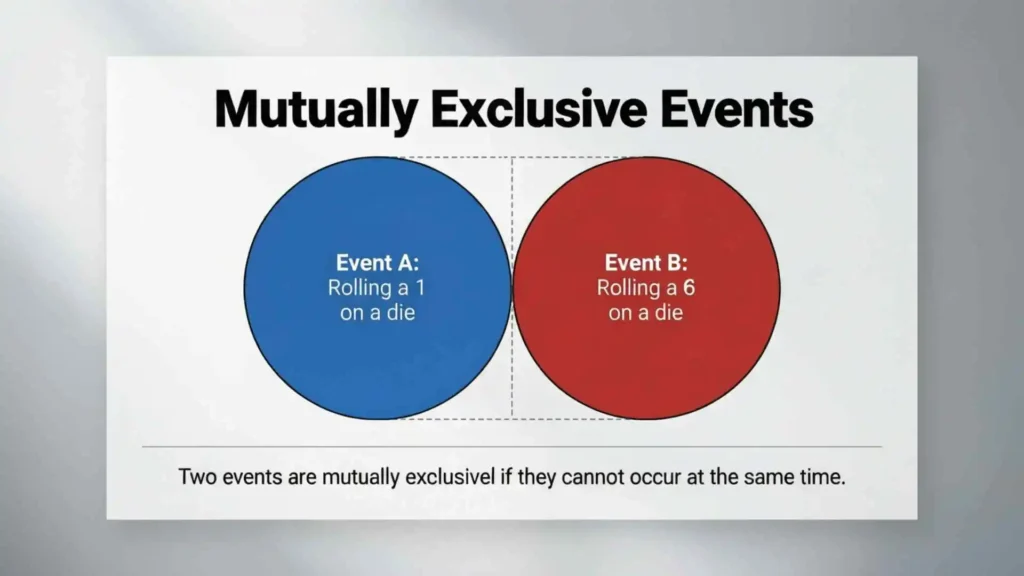
Mutually exclusive means that if one event occurs, the other cannot happen at the same time.
Example: Flipping a coin—getting heads and tails simultaneously is impossible; these outcomes are mutually exclusive.
Literal Meaning of Mutually Exclusive
- Mutually = in relation to each other; reciprocally.
- Exclusive = not shared; preventing others.
Together, it literally means “cannot happen together.”
Mutually Exclusive in Everyday Life
- Traffic Example: Turning left and right at the same time is mutually exclusive.
- Food Choice: Drinking coffee and tea in the same cup is mutually exclusive.
- Work Example: Working two full-time jobs at the same hours is mutually exclusive.
- Technology Example: A device cannot connect to two Wi-Fi networks simultaneously—mutually exclusive.
Mutually Exclusive in Probability
In math and statistics, two events are mutually exclusive if the probability of both occurring at the same time is zero.
Examples:
- Rolling a die: getting a 3 and 6 in a single throw is impossible.
- Drawing a card: picking a spade and a heart from a standard deck in one draw is mutually exclusive.
Mutually Exclusive vs Not Mutually Exclusive
- Mutually exclusive: One event happening prevents the other.
- Not mutually exclusive: Events can occur together.
Examples:
- Mutually exclusive: Flipping a coin—heads or tails.
- Not mutually exclusive: Being a student and an athlete—both can happen together.
Venn Diagram Explanation
A Venn diagram can help visualize mutually exclusive events:
- Two non-overlapping circles represent events that cannot happen together.
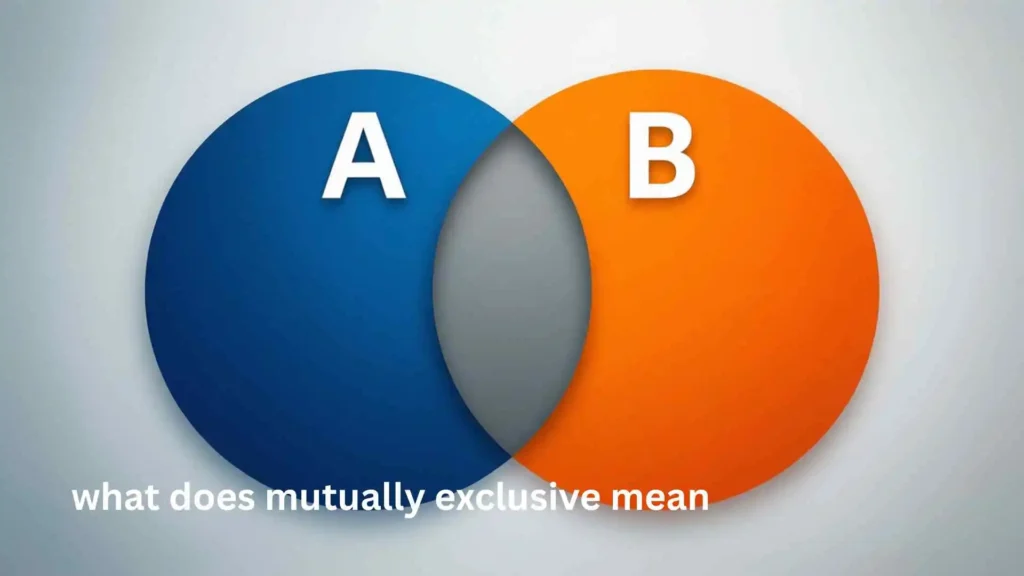
- If circles overlap, the events are not mutually exclusive.
Common Confusions About Mutually Exclusive
- Mutually exclusive ≠ independent events: Independent events can happen together but do not affect each other’s probability.
- It doesn’t mean unrelated forever: Mutually exclusive refers only to specific outcomes at the same time.
How to Identify Mutually Exclusive Events
Quick Checklist:
- Can both events happen simultaneously?
- Is the probability of both = 0?
- Are the outcomes logically impossible together?
If the answer is yes to both 1 and 2, the events are mutually exclusive.
Pronunciation of Mutually Exclusive
Mutually exclusive is pronounced: “myoo-chuh-wuh-lee ik-SKLOO-siv.”
Why Understanding Mutually Exclusive Matters
- Logic: Avoid contradictions and clarify reasoning.
- Probability: Simplifies calculations for statistics, games, and predictions.
- Daily Life: Helps make clear decisions when choices cannot overlap.
- Exams & Education: Understanding this concept helps with math, probability, and logic problems.
Final Thoughts
Mutually exclusive means that two events or outcomes cannot happen at the same time.
Knowing this concept is useful in logic, probability, exams, and everyday decision-making, helping you recognize situations where events cannot coexist.
Discover More Topics:
- What Does It Mean When a Ladybug Lands on You | Luck, Love & Spiritual Meaning 2026
- What Does Mames Mean | Complete Guide

Lyra Wren is a contemporary fiction author who writes lyrical, emotionally driven stories exploring identity, healing, and the quiet power of inner transformation.
Books by Lyra Wren
-
Petals in the Quiet Wind
-
The Soft Weight of Becoming